
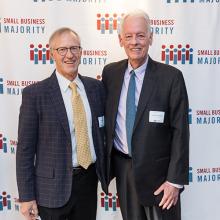
Over the course of this year we’ve looked back at two decades of milestones, people and issues that have helped shape Small Business Majority’s work to build a thriving and inclusive economy. But for our final blog in this series, we’re looking ahead as our Founder & CEO, John Arensmeyer, shares his thoughts on where we’re going as an organization and what it will take to get there so that we can continue to help small businesses succeed for another 20 years – and beyond.

While every entrepreneur sets out to build a successful business, a lack of reputable resources and guidance can leave even the most experienced small business owner unsure of where to start or how to sustain their growth. That’s why Small Business Majority has worked to equip small business owners with the support they need through our online resource hub, Venturize. Here, business owners can access expert guidance, safe capital and the tools they need to strengthen and scale their small businesses.
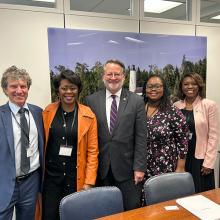
At Small Business Majority, our guiding belief is simple: the strongest policy solutions come directly from the people who run small businesses every day. Entrepreneurs know their challenges better than anyone, and they deserve a meaningful role in shaping the policies that affect their livelihoods. Our national and state-based small business councils are one way we make this possible by giving small business owners a formal platform to guide our mission, influence policy and strengthen small business ecosystems nationwide.
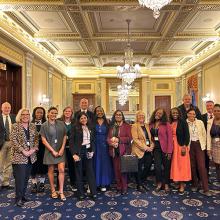
For two decades, Small Business Majority has worked to ensure that entrepreneurs don’t just navigate policy decisions—they help shape them. From advocacy fly-ins on Capitol Hill to testimony in state and federal hearings, we’re creating real opportunities for small business owners to share their stories, influence legislation, and make their voices heard where it matters most. Read more about how we’re elevating small business voices.

For 20 years, Small Business Majority has shown that meaningful change for entrepreneurs often starts in the states. From helping implement the Affordable Care Act in California to advancing paid leave, retirement programs, Medicaid expansion and more across 13 states and D.C., our Outreach Team members have driven policy innovation and empowered small business voices in local decision-making. Read this blog to learn how our state-focused advocacy model took shape and how it continues to spark progress for small businesses nationwide.

All too often, lawmakers fail to recognize the relationship between policy decisions and the impact they have on small businesses. Small Business Majority helps people in power make that connection in a variety of ways, including by conducting our own original research. Since our earliest days, we’ve utilized scientific opinion polling on the national and state levels to determine small business owners’ views on a range of topics like access to capital, healthcare and workforce issues, and also to learn about how various issues and challenges are actually impacting their businesses. We then use these findings to drive our advocacy work.
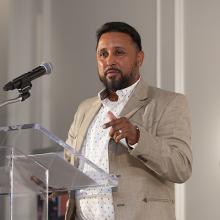
For many justice-impacted individuals, small business ownership isn’t just a dream—it’s often the only path forward. Entrepreneurs like Ruben Mauricio are proving that with determination and the right support, second chances can lead to thriving businesses and stronger communities. Learn how they’re overcoming systemic barriers to build better futures.

Small business ownership has long been recognized as a path to financial freedom and independence, but many entrepreneurs are held back by big businesses that game the system in their favor – in both digital spaces and in the real world. This uneven playing field dominated by large businesses leaves small business owners struggling to keep up. That’s why for the past 20 years, Small Business Majority has worked to level the terrain by exposing the tools big businesses use to gain a leg up on their smaller competitors including working to ban non-compete agreements, enforce price discrimination laws and advancing policies that promote fair competition.

The pandemic pushed small businesses into the digital age faster than anyone expected. Some were able to pivot quickly—launching online stores, expanding their social media presence, or streamlining operations with new tools—but others struggled to keep up. To help better understand the evolving playing field, in 2023 Small Business Majority launched a comprehensive digital transformation research project to uncover what small businesses need to thrive in this new era and ensure they aren’t excluded from the opportunities found in a changing economy. Read more to see how small businesses are adapting, where gaps remain, and what steps can help every business succeed in a rapidly evolving digital world.

Tax policy can be confusing, and too often reforms benefit large corporations rather than small business owners. Since 2017, Small Business Majority has fought to ensure meaningful relief reaches Main Street entrepreneurs, sharing stories from real business owners who have been impacted by the tax code. Read more about these stories and our ongoing fight for fair tax reform for small businesses.
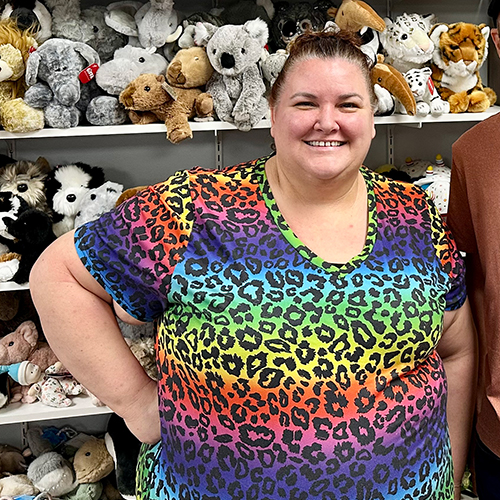 Small businesses are the backbone of our economy, driving nearly half of GDP and employing 59 million Americans. Yet rising costs—from healthcare to rent to tariffs—are putting enormous pressure on entrepreneurs and their employees. Entrepreneurs like Margo Clayson in Idaho and Megan Wyatt in California are feeling the pinch as tariffs drive up costs, forcing them to make tough choices about prices, jobs, and survival. Our latest blog explores how these policies ripple through Main Street and why Small Business Majority is fighting to ensure small businesses remain the true engine of our economy.
 When the COVID-19 pandemic brought the world to a halt in 2020, small businesses faced enormous challenges—but they also showed remarkable resilience. Small Business Majority quickly mobilized with daily webinars, timely research, and strong advocacy to ensure entrepreneurs had the resources and support they needed. From amplifying small business voices in the media to pushing for fairer relief programs, our work during this period continues to shape policies today. Read how small businesses navigated the pandemic.

When Jay-Mee Del Rosario immigrated from the Philippines as a child, her path to entrepreneurship was filled with obstacles—from being denied college due to her immigration status to facing limits on growing her California metals distribution business without U.S. citizenship. Her story reflects the systemic barriers immigrant entrepreneurs continue to face, despite making up nearly 1 in 5 new businesses and contributing significantly to our economy. At Small Business Majority, we’re working to remove these barriers—whether through advocating for fair licensing laws, expanding healthcare access, or pushing for meaningful immigration reform—so immigrant entrepreneurs can fully participate in and strengthen our economy.

Access to childcare isn’t a concern that’s limited to parents—it’s also a business issue. Across the country, small business owners and their employees struggle to find and afford quality childcare, forcing too many caregivers to choose between their jobs and their families. In fact, according to Small Business Majority’s 2024 national poll, 58% of entrepreneurs report that childcare challenges have made it harder to start their business, while 59% say these challenges have slowed their growth. For more than one in four, the impact was even more severe and they were forced to close their business altogether.

Nearly 80% of small business owners support a national paid family and medical leave (PFML) program, yet in the absence of federal action, states are stepping up. Small Business Majority has been at the forefront of this movement, helping shape programs like Colorado’s FAMLI through research, advocacy, and small business voices. Read about our efforts and hear directly from small business owners on why PFML matters.
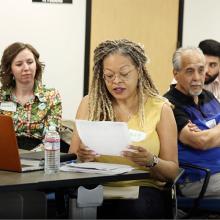
At Small Business Majority, we know small businesses don’t succeed in a vacuum, they thrive when surrounded by a strong, connected support system. That’s why we’re committed to building small business ecosystems: networks of community organizations, mission-driven lenders, service providers, and policymakers working together to help entrepreneurs start, grow, and scale their businesses.
Rural entrepreneurs face a unique set of challenges compared to their urban and even their suburban counterparts. Poor infrastructure including limited broadband internet, as well as a lack of access to hospitals, doctors, and childcare providers can make it difficult for rural economies to thrive. And while many cities have dedicated programs to support under-resourced small businesses, that often isn’t true in rural areas. That’s why small business advocacy organizations must help fill the resource void in rural America.
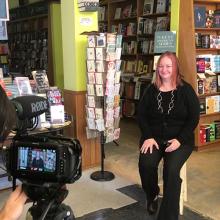
Many small business owners struggle to save for retirement or offer benefits due to cost and limited resources. That’s why Small Business Majority has long supported state and federal auto-IRA programs like California’s CalSavers, which provides no-cost retirement savings options for workers and helps small firms compete for talent. One early participant, bookstore owner Christin Evans, shares how CalSavers improved retention and professionalism at her business. With 20 states now offering similar programs, thousands more entrepreneurs and employees can plan for a more secure future—yet continued advocacy remains essential.

One of the biggest barriers to entrepreneurship is capital. It’s often so hard to get, in fact, that many early-stage small business owners resort to borrowing from friends and family, or risking their life savings to support their dreams. In addition to the deceptively high interest rates, one of the most insidious aspects of predatory loans is that business owners who are victimized by bad-faith lenders tend to also feel shame. That’s why we’re grateful for small business owners like Chrishon Lampley, a member of our Illinois Small Business Council, who has regularly shared her predatory lending story over the years to help others avoid the same pitfalls.
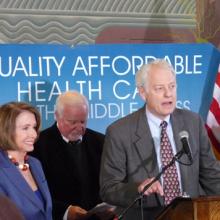
When John Arensmeyer launched Small Business Majority in 2005, he was trying to fill a gap in the advocacy space. As a former small business owner himself, he recognized that the overwhelming majority of entrepreneurs didn’t have the resources to receive meaningful attention from their elected officials. He also saw that most of the small business advocacy groups at the time tended to conflate the needs of big businesses with the needs of small firms.


