


Meet our New York Director, Lindsey Vigoda
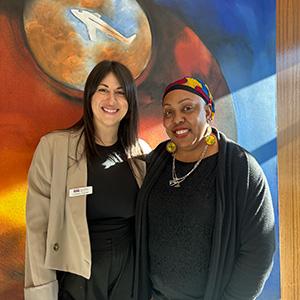
Lindsey Vigoda opened our New York office two years ago after five years with our Colorado Team. Our outreach team helps entrepreneurs on two fronts: It advocates for policies that benefit small businesses and it offers webinars and in-person events that offer entrepreneurs tips on how to grow their businesses. This work is more important than ever as the United States has seen record small business growth in recent years, yet we still struggle nationwide to help small businesses access capital, afford healthcare and childcare, and compete on a level playing field with large corporations.
We’re pleased to spotlight Lindsey so our network can get to know her and learn more about the work she is doing to support small business owners in New York.
What is your role at Small Business Majority?
Currently, I serve in a dual capacity as the New York Director and the National Quality Jobs Policy Director, shaping all of our state advocacy here in New York while advising on our work across the country and in Washington, DC pertaining to the creation of quality jobs, including childcare and paid family leave.
Reflecting, I cannot believe I have been with Small Business Majority for more than seven years. Coming from a background in social work, the path to becoming a small business advocate wasn't one I initially envisioned, yet now I cannot imagine anything more fitting.
What do your responsibilities in this role look like?
In this role, my responsibilities are multifaceted and require strategic coordination. I develop and maintain strategic partnerships across New York, organizing the small business community to ensure their collective voice is heard, and spearheading advocacy and lobbying efforts to influence meaningful policy change. Additionally, I collaborate on our development strategy to ensure our programs remain sustainable and impactful.
What has your experience working with the New York small business community taught you about the needs of entrepreneurs in the state?
Working with the New York small business community has been a masterclass in the discrepancy between economic importance and political influence. While these entrepreneurs are the lifeblood of our local neighborhoods and the pulse that sustains our social fabric, my experience has taught me that there is a profound representation gap that leaves many small business owners feeling sidelined by the very systems meant to support them.
I have spent the last several months traveling around the state and convening roundtables to better understand the needs of small business in states.
What I have learned is that New York entrepreneurs are incredibly resilient, but they are tired of being treated as a monolith or a photo-op. They need a systemic shift that prioritizes the Main Street economy,ensuring fair competition and a level playing field to help small businesses compete as increasing corporate consolidation limits their ability to grow.
How is Small Business Majority working to address these challenges and support small business owners?
Small Business Majority works to get small business owners to the table and create a system where entrepreneurs can convene their own tables for elected officials and key stakeholders. Meeting with elected officials to share these real experiences and creating a strategy to ensure small businesses cannot be ignored.
We address these systemic gaps by moving beyond traditional advocacy and focusing on shifting the power dynamics between policymakers and the Main Street economy. Our work is centered on ensuring that small business owners are no longer just the subjects of legislation, but the architects of it.
Looking ahead, what do you hope to accomplish in this role?
In a state where Wall Street and corporate power are so prevalent, my goal is to create opportunities for small businesses to have a sustainable platform, one that cannot be ignored. I want to co-build this platform alongside small business owners so that it remains a constant presence, regardless of the current political cycle. To be an aide in the creation of a system where small business owners finally have the tools, the access and the organized power needed to thrive for years to come.
Why are small businesses so important to communities across New York, and why is it critical to continue elevating their stories and voices?
Small businesses are essential anchors of New York’s diverse landscape, acting as much more than commercial entities. They shape the identity of our neighborhoods, providing the cultural soul and social cohesion that distinguish a historic upstate town from a bustling street in Queens. Through my travels across the state, I have seen how in our rural communities, small businesses often serve as economic lifelines, driving job creation and access to essential goods and services. No matter where we are, without small businesses, our communities risk losing the unique character and heritage that make New York a global destination and a place we call home.
It is critical to elevate small business owners’ stories because they represent a form of local power that is increasingly vital in today’s world. When we can’t rely on the federal government to support our communities, and there is so much political division, small businesses are our North Star for economic power, resiliency, and a rare space where neighbors still connect across differences. By championing the stories of these entrepreneurs, we aren't just supporting a business model—we are defending the very essence of what it means to live and thrive in New York.
If you had to choose one word that captures the spirit of small businesses, what would it be and why?
Resiliency. I find myself returning to this word constantly in my work because, to me, every small business owner is a hero. In 2026, the landscape of entrepreneurship is not for the faint of heart. It requires a level of grit and adaptability that is rare, yet more necessary today than ever before. Calling these entrepreneurs "heroes" isn't hyperbole. Their resiliency is the backbone of our state’s economy and the primary reason our communities remain vibrant, connected and uniquely ours.