


20 stories for 20 years: Creating a better economy for small businesses
Small businesses generate 43.5% of GDP and employ about 59 million people, making them a driving force in our economy. Although they create opportunity and power communities, rising costs – exacerbated recently by tariffs– threaten their sustainability. Small Business Majority has worked to address these challenges over the years by advocating for policies that help promote an economy in which small businesses can thrive.
Of course rising costs are nothing new to small business owners, but costs have accelerated substantially since the COVID-19 pandemic. In many cases, rising expenses have forced small businesses to make tough decisions between absorbing costs or raising prices. In fact, our research found in 2022 that 80% of small business owners had been negatively impacted by inflation at that time, and nearly 1 in 4 said they might not survive the next six months without additional funding or market changes.
To help support small businesses, Small Business Majority advocated in support of the Inflation Reduction Act of 2022. This work included sending two letters to Congress, one signed by more than 250 advocates and small business owners, urging lawmakers to approve the legislation. The bill, which later became law, closed tax loopholes that hinder small business growth and made healthcare more affordable by lowering prescription drug prices and extending the Affordable Care Act’s premium subsidies through 2025.
While the Inflation Reduction Act was a win for small businesses facing rising costs, ever-changing healthcare policies continue to leave entrepreneurs facing an increasingly uncertain future. This year, Congress passed the One Big Beautiful Bill Act, which made steep cuts to Medicaid and failed to renew the ACA’s enhanced premium tax credits. Small business owners and their employees rely on these credits to lower monthly premiums, and without action from Congress, roughly 5 million entrepreneurs and millions more small business employees will face significantly higher costs. To support them, Small Business Majority has released timely research and fact sheets, amplified small business voices and produced educational blogs, all to advocate for the extension of these vital tax credits.
Unfortunately, threats to affordable healthcare aren’t the only factors contributing to rising costs for small business owners. Historically, small business owners have always operated on thin margins, but since the COVID-19 pandemic entrepreneurs have found it increasingly difficult to keep up with commercial rent and mortgage payments. As a result, Small Business Majority has stepped in to strengthen support in this area at the state level.
In California, for example, Small Business Majority worked to advance legislation that would allow counties to implement local rent forgiveness and tax relief programs for small business owners and their landlords. Legislation like this helps small businesses stabilize cash flow and reinvest in their growth without being held back by debt.
More recently, in Colorado we’ve advocated for greater protections for small business owners who are sometimes subjected to surprise fees for common area maintenance (CAM) in properties where they rent commercial space.. To strengthen our advocacy, we’ve elevated the experiences of business owners in our network like LeToya Garland, who unexpectedly received a $9,000 bill in back-charged CAM fees. Earlier this year, Colorado lawmakers passed a bill that prohibits landlords from charging CAM fees starting in 2026.
Although many of the cost-related problems that Small Business Majority has worked to address over the years are nothing new for entrepreneurs, perhaps the biggest single problem today was on few small business owners’ minds until just recently: tariffs.
The current administration has argued that tariffs are a way to boost domestic manufacturing and reduce the U.S. trade deficit; however, these taxes on imported goods and materials, paid by domestic businesses, are driving up costs and creating serious financial strain for small businesses nationwide. For entrepreneurs like Margo Clayson, founder and president of The Mighty Microgreen in Inkom, Idaho, tariffs are her biggest concern right now.
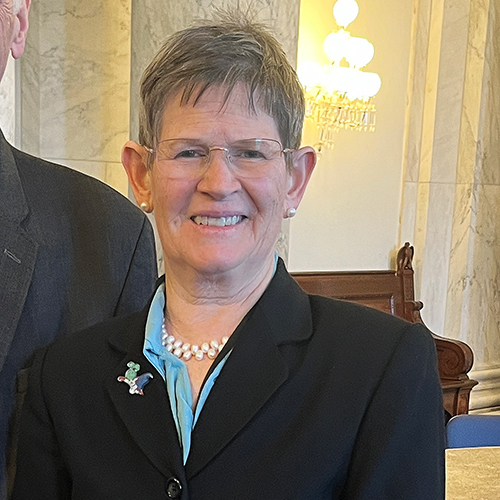 “I source everything I can locally, but some materials—like plastics—are simply not affordable in the United States. If I have to raise prices in response to my increasing costs, I know families will then have to make tough choices. No matter how great my product is, it’s likely to end up on the back burner in family budgets,” Margo said.
Tariffs have significantly impacted many small businesses just like Margo’s. Small Business Majority’s quarterly Voice of Main Street opinion poll series, which examines the challenges that entrepreneurs in our network are facing, found earlier this year that 60% of small businesses report they’ve experienced higher costs for imported materials or goods due to recent tariff increases. Of these businesses, more than half (57%) say their costs have increased by 10% to 25%. As a result, Small Business Majority has jumped into action to tackle rising tariffs.
In response to increased tariffs Small Business Majority submitted a written testimony to members of the United States Senate Committee on Finance to raise awareness about the impacts of trade policy decisions on our nation’s small businesses. Additionally, we’ve worked to elevate the voices of small business owners in this matter when SBM board members LaJuanna Russell and Michael Negron testified in the U.S. House of Representatives on this issue.
A large part of our work surrounding tariffs has also been to increase access to education on this topic. We’ve produced fact sheets to help advocates and lawmakers understand the impact of tariffs on small business owners. We’ve also published educational material on what small businesses need to know about tariffs on our resource site, Venturize.org, and hosted several webinars to help small businesses navigate changes to tariff policy.
Our work to ensure small business owners have access to a supportive economy that actually works for them is ongoing, but progress is only possible when lawmakers consider the small business perspective and small business owners' voices are heard. By lifting up the experiences of entrepreneurs and advocating for policies that address inequities, Small Business Majority is helping ensure small businesses can do much more than simply survive.
 “I am very grateful for Small Business Majority. Their webinars and emails have been very informative and have been a great source of information for what is going on in the ever-changing world of tariffs. But most importantly, it's been a big help just to know that there is someone in our corner fighting for us. Small Business Majority has given me hope that leaders and politicians will hear our stories and do something to help us,” said Megan Wyatt, owner of Wit & Whimsy Toys in Granite Bay, Calif.
20 Stories for 20 years
Since our founding in 2005, Small Business Majority has worked to empower America’s diverse entrepreneurs to build a thriving and inclusive economy through a mix of advocacy and education. But none of what we do would be possible without the people and organizations who lend their support – and their voices. As we recognize our 20th anniversary, we believe it’s important to honor those who helped us improve the landscape for small businesses over the years. One of the ways we’re doing that is through a series of 20 stories that reflect on the past and present of Small Business Majority, and also celebrate the ways in which we have worked as a collective to advance our mission to level the playing field on behalf of America’s entrepreneurs.