


Voice of Main Street: Small businesses being strained by rising costs
Amid growing concerns around the country about rising costs and a lack of affordability across our economy, Small Business Majority’s latest research finds that most small businesses say their expenses increased while nearly half of small firms saw their revenue decline over the past three months.
Voice of Main Street, a quarterly opinion poll of entrepreneurs in Small Business Majority’s network, finds nearly two-thirds (64%) of small business owners report their business expenses have risen over the past three months while only 9% say they have decreased. Meanwhile, nearly half (47%) of small businesses say revenue has declined over the same period.
The poll reveals small businesses are facing a number of financial challenges that are limiting their growth potential: 82% of small business owners say increased costs of supplies and inventory are a challenge facing their business, while 81% cite reduced consumer spending as a concern. Additionally, 71% of small businesses report difficulty making payroll and/or paying business expenses.
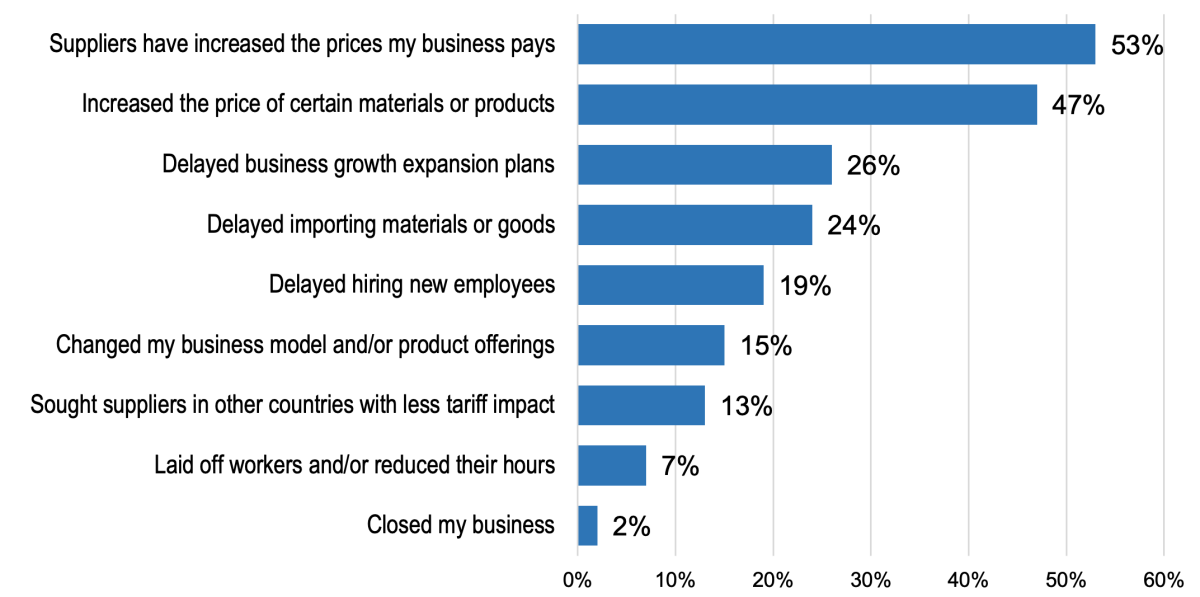
Many of these challenges can be connected to tariffs and rising business expenses. Thirty percent of small businesses say they have paid tariffs on imports for their businesses, and 71% of all respondents report they have been negatively impacted by tariffs. Meanwhile, 71% report that their healthcare premiums have increased over the past year, while just 2% report their healthcare costs have decreased. More than 8 in 10 (81%) report their utility costs are on the rise.
Figure: Most of small business owners report some form of negative impact from tariffs
Amid these rising expenses, small business owners also say they’re being harmed by corporate consolidation and monopolistic practices. Therefore, it’s not surprising that a strong majority of small businesses think that the federal government should do more to regulate monopolies. As small businesses struggle to keep up, the majority of entrepreneurs are using some AI tools in their businesses, yet they have concerns about tools provided by major companies.
Additional key findings
- Less than half (47%) of small businesses are optimistic about their business prospects over the next six months while 36% are pessimistic.
- As a result of rising costs and other economic conditions, small business owners report a number of impacts, including that they increased prices on their goods or services (65%), delayed business investments (37%), froze hiring (20%) and laid off employees (8%).
- Small businesses also share how corporate consolidation and monopolistic practices are impacting Main Street. Small businesses are being harmed by self-preferencing, where larger companies’ own products or services appear first on a platform or search engine (35%); predatory pricing (28%); price discrimination (25%) and more. More than two-thirds (67%) agree the federal government is not doing enough to regulate monopolies, and 65% percent believe their state should do more to strengthen its anti-monopoly laws and enforcement.
- Some small businesses are wary of integrating AI: More than one-third (36%) of small businesses are not currently using AI in their business, indicating concerns about data privacy (50%), accuracy of AI outputs (48%), security risks (42%), protection of intellectual property (41%) and lack of staff expertise (39%). These concerns are also shared by small businesses that are using AI tools.
