


Opinion Poll: American Voters Want Elected Officials to Support Small Business
America is a nation powered by entrepreneurship. With more than 36 million small businesses that make up 99.9% of all American businesses and employ more than 62 million workers, small businesses are central to American life and the economy. Entrepreneurs in Main Streets across the country give towns their unique character and are pillars of their local communities. They create opportunities and keep the economy vibrant and competitive while following their passions and pursuing the American Dream. Despite their centrality to American life, small businesses and their needs are too often overlooked by elected officials and candidates seeking public office.
This national opinion poll of likely voters, conducted for Small Business Majority by Lake Research Partners, reveals overwhelming bipartisan support for small businesses and pro-small business policies. Voters believe by dramatic margins that the success of small business is better for their families and the economy than the success of large corporations, and it’s personally important to them that local small businesses in their communities thrive.
Importantly, voters strongly believe that conditions have worsened for small businesses over the past year. More than three quarters, including majorities across party lines, believe that small businesses are bearing the brunt of dramatic increases in the cost of living, that large corporations are raking in huge profits, and that we need elected leaders who stand up for small businesses and the American Dream while fighting against monopolies and power consolidation.
As voters indicate small businesses are confronting increasing challenges, they believe that the cost of healthcare, taxes and unfair competition are the most pressing problems for small businesses today. They’re more likely to vote for candidates who support small business policies that would address these and other issues related to affordability. In particular, the research reveals that voters across party lines are much more likely to support policymakers who would work to reduce the cost of healthcare and prescription drugs, as well as those who support access to more affordable healthcare for small business owners and their employees. They are strongly supportive of statements that highlight the need to level the playing field for small businesses, and they want elected officials to fix the tax system to benefit small businesses instead of large corporations.
This poll illustrates the strength of small business as an issue for elected officials and those who seek public office. Political leaders would do well to show their constituents that they care about small business and will fight for policies that benefit Main Street over large corporations.
Key findings
- The vast majority of voters believe the success of small businesses is better for their families (73%) and the economy (83%) than the success of large corporations.
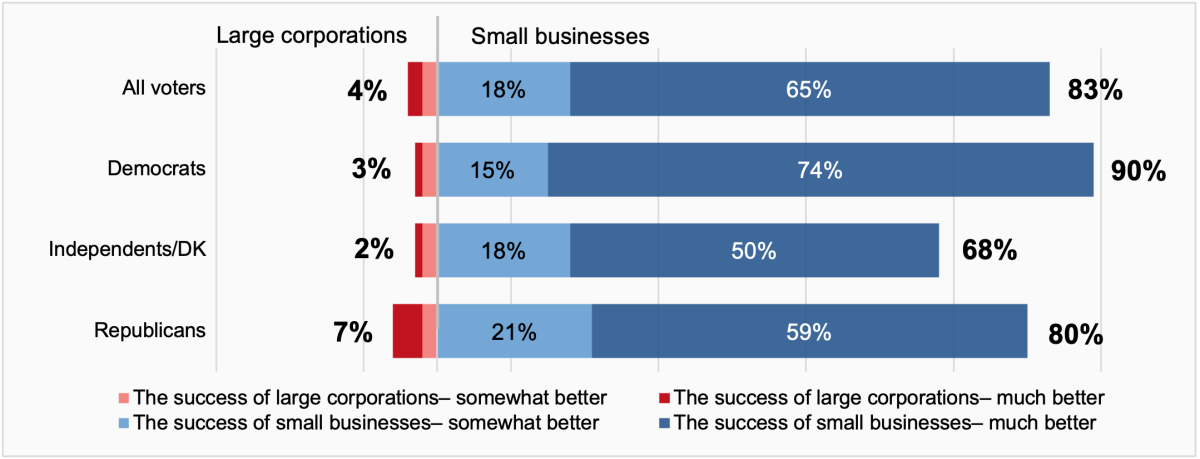
- American voters want small businesses to thrive. Nearly 9 in 10 (89%) say the success of small business is important to them personally, and this holds true across party lines and demographics.
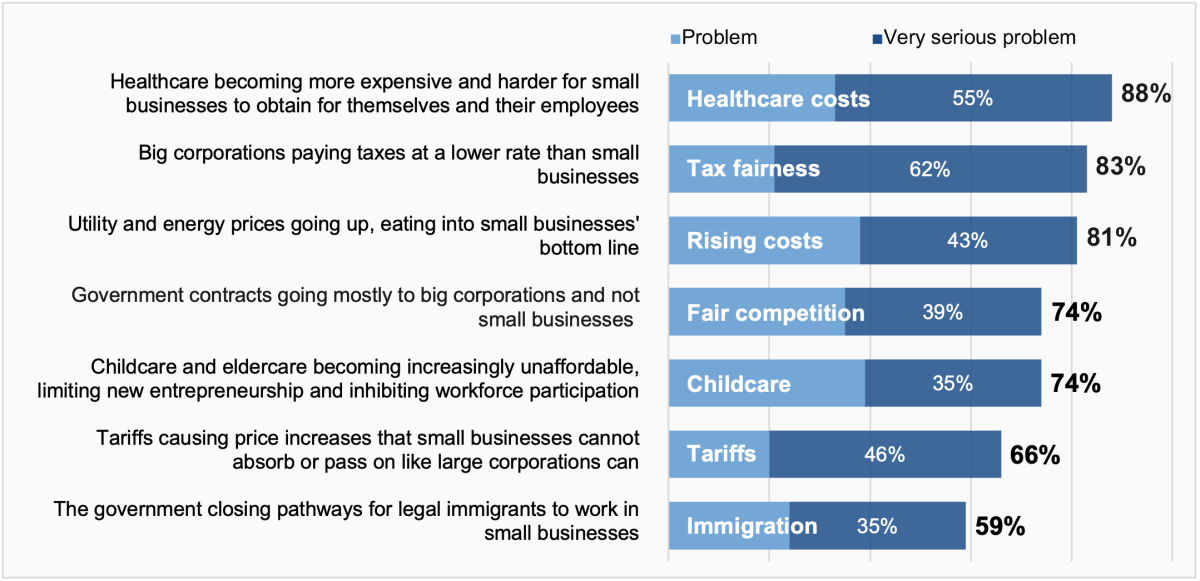
- An overwhelming majority of voters believe that healthcare and an uneven playing field are the biggest issues for small businesses. They say that healthcare becoming more expensive and harder to obtain (88%) and big corporations having loopholes to pay less taxes (82%) are problems for small businesses.
Figure: Voters identify the most pressing problems facing small businesses
- Policies that address rising costs and affordability resonate broadly. Almost all Democrats (94%), 80% of independents and 59% of Republicans are convinced that the cost of living is rising with small businesses bearing the brunt, and that elected officials should stand up for small businesses while fighting against monopolies.
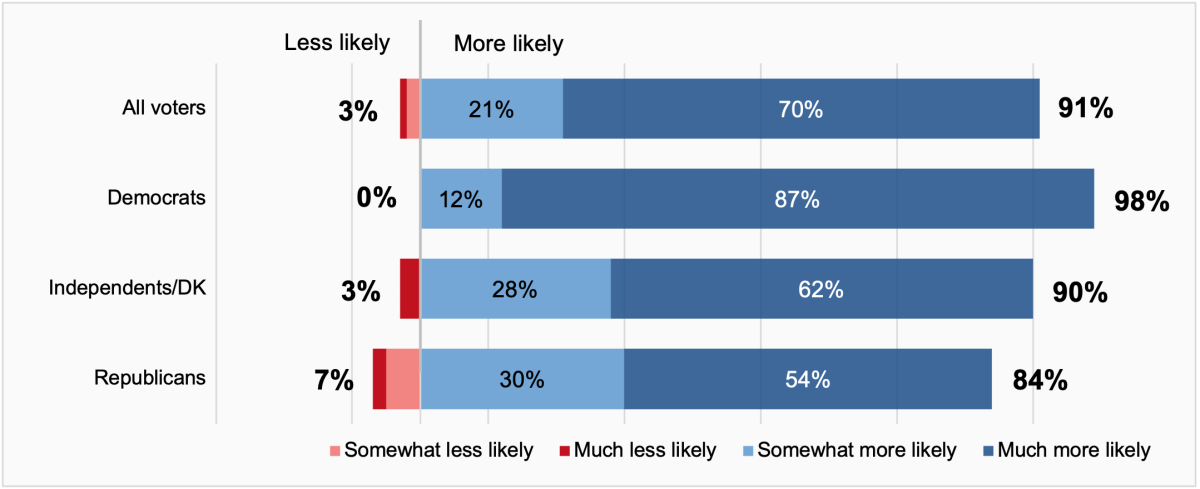
- Voters across party lines are much more likely to support candidates who favor policies that reduce small business healthcare costs. Ninety-one percent are more likely to vote for a candidate that would support policies reducing the cost of healthcare including prescription drugs, with 89% of Democrats, 73% of independents and 64% of Republicans much more likely to vote for that candidate. Additionally, 91% are more likely to vote for a candidate that believes small businesses should be able to access affordable healthcare for themselves and their employees.
Figure: Majority of voters across party lines would support candidates who back access to affordable healthcare for small business owners and their employees
- Across party lines, voters support the need to level the playing field between small businesses and large corporations. Nearly two-thirds (65%) of Democrats, half of independents (50%) and 43% of Republicans are very convinced that elected officials need to fight for small businesses instead of large corporations and that they need to level the playing field.
- Additionally, voters are more likely to support candidates who support tax policies that benefit small businesses over large corporations. The vast majority (85%) are more likely to vote for a candidate who thinks that the government should fix the tax system to benefit small businesses instead of large corporations, and across party lines, 86% of voters are more likely to vote for a candidate who believes that “we should ensure government tax incentives go to Main Street businesses and not to large AI companies.”
- Many respondents report connections to small businesses, underscoring the importance of small business to households across the country. About one-third (34%) say they or someone in their household is a current or retired entrepreneur. Similarly, 34% of respondents say they or someone in their household is a current or retired small business employee. Nearly half (48%) of voters fall into at least one of these two categories.
